

Happy Easter

As Easter arrives this year, it feels like the world hasn’t taken a day off from the noise. The headlines keep coming—markets shifting, geopolitics evolving, and uncertainty never too far from the front page.
And yet, Easter is a useful reminder that renewal doesn’t require calm conditions—it happens in spite of them.
From my vantage point, one constant throughout this has been the importance of perspective. While short-term volatility and attention-grabbing news cycles can feel overwhelming, the long-term discipline of thoughtful planning and steady decision-making continues to prove its value. That’s as true today as ever.
I’m grateful for the trust you place in Babylon Wealth Management and in me. It’s a responsibility I don’t take lightly, especially in times like these.
Wishing you and your families a peaceful Easter, one that offers a bit of quiet, a reset where you can find it, and optimism for what’s ahead.

Resilience Amid Geopolitical Crosscurrents
This past week offered a reminder of just how quickly sentiment can shift. Equities broadly moved higher, with the S&P 500 up 1.18% and the equal-weighted index gaining 1.37%, while the Dow Jones led large caps with a 2.04% advance. Strength was even more pronounced in smaller companies, as the Russell 2000 climbed 3.90%. Globally, markets followed suit, with the MSCI ACWI up 2.12%.
At the same time, we saw a notable divergence across alternative asset classes. Bitcoin pulled back 4.81%, while gold rallied sharply by 4.40%. This flight to quality followed a volatile week in the Middle East, marked by the first U.S. aircraft losses of the conflict and a drone strike on a corporate headquarters in Dubai. These events served as a stark reminder that while the frontline remains overseas, the risks of regional escalation continue to weigh on investor psychology.
Interestingly, Energy was a drag this week, with Brent oil down 6.62%. This decline reflects a market currently torn between the reality of supply disruptions in the Strait of Hormuz and growing concerns that a prolonged conflict could stifle global demand. Taken together, it was a week that underscored both the current resilience in equities and the complex, shifting crosscurrents beneath the surface.
S&P 500: 1.18%
S&P 500 EW: 1.37%
Dow Jones: 2.04%
Nasdaq: 1.07%
Russell 2000: 3.90%
MSCI ACWI 2.12%
Bitcoin: -4.81%
Gold: 4.40%
Brent Oil: -6.62%
WTI vs Brent: The Great Inversion
For most investors, “oil is oil.” However, the professional world tracks two distinct benchmarks: WTI (the U.S. standard) and Brent (the global standard).
The Basics: WTI vs. Brent
WTI (West Texas Intermediate): Sourced from U.S. fields (primarily the Permian Basin) and settled in Cushing, Oklahoma. It is “light” and “sweet,” meaning it’s easy to refine into gasoline.
Brent Crude: Sourced from the North Sea but used as the pricing floor for two-thirds of the world’s internationally traded oil.
Why the “Spread” Matters
Historically, Brent trades at a premium of $3 to $7 over WTI. This isn’t because Brent is better; it’s actually slightly “heavier” and “sourer” (more sulfur) than WTI. Brent is more expensive simply because it is waterborne; it can be loaded onto a tanker and sent anywhere in the world immediately. WTI, being landlocked in Oklahoma, often suffers from “pipeline traffic jams,” which keeps its price lower.
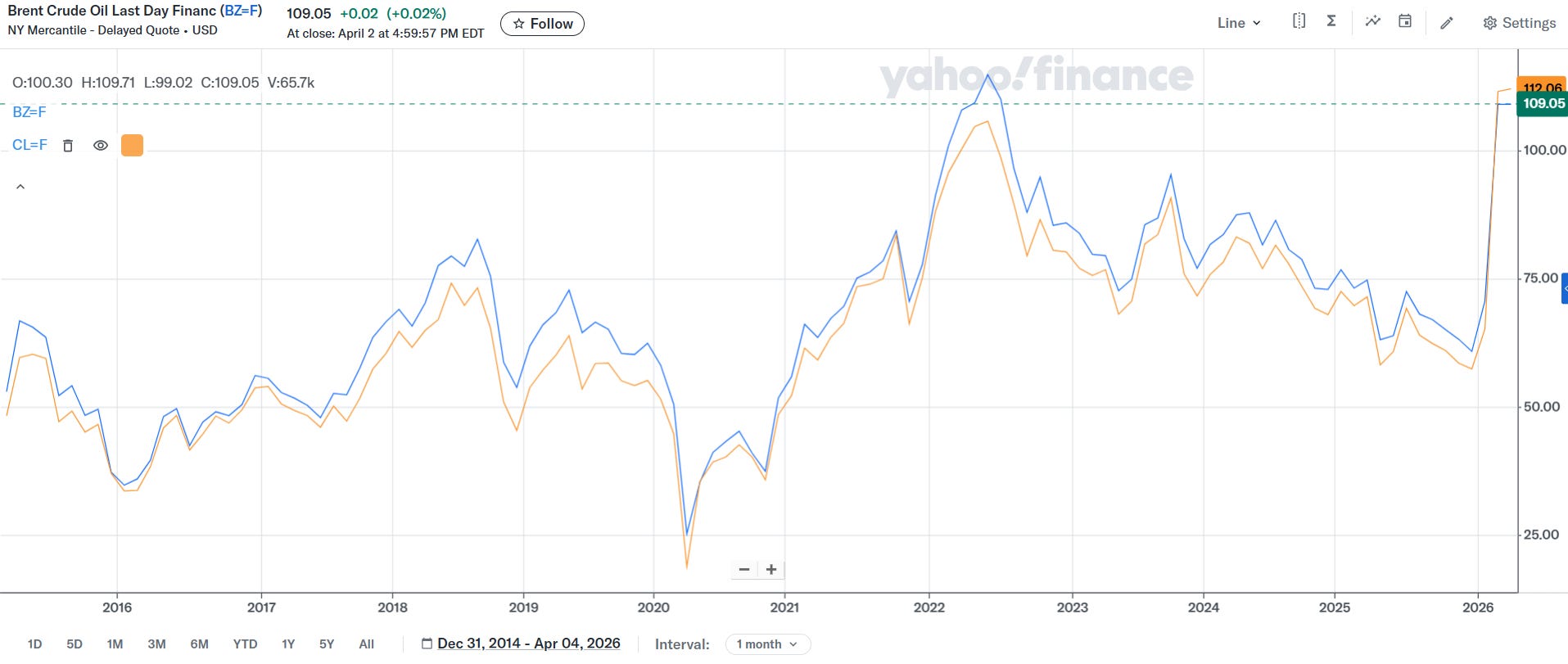
When WTI passes Brent in the modern era, it is usually a signal of extreme global distress or a sudden shift in U.S. export capacity.
2015 (The Export Ban Lift): In late 2015, when the U.S. Congress lifted the 40-year-old ban on crude oil exports, WTI briefly tested parity with Brent. It was a “relief rally” as the market realized U.S. oil could finally flow to global buyers.
April 2020 (The COVID Crash): While WTI famously went negative ($37), the spread inverted several times in the weeks leading up to the crash as global demand collapsed and Brent (exposed to international shipping) fell faster than domestic U.S. prices initially did.
Today (April 2026): We are currently seeing a rare inversion. With WTI at $112.06 and Brent at $109.23, the market is pricing in a “security of supply” premium.
The 2026 Anomaly: WTI Takes the Lead
As of this week, we are witnessing a rare market “inversion.” With the Strait of Hormuz facing a virtual blockade and President Trump’s recent address signaling a prolonged military stance, the global “Brent” market is in chaos.
However, WTI is currently trading at a premium to Brent, which is telling us two things about the current macro environment:
Security of Supply: Global buyers (especially in Asia) are fleeing Middle Eastern uncertainty and outbidding each other for guaranteed U.S. barrels.
U.S. Energy Insulation: While global shipping lanes are under threat, WTI’s landlocked nature, once a disadvantage, is now its greatest strength. It is perceived as a “safe haven” barrel.